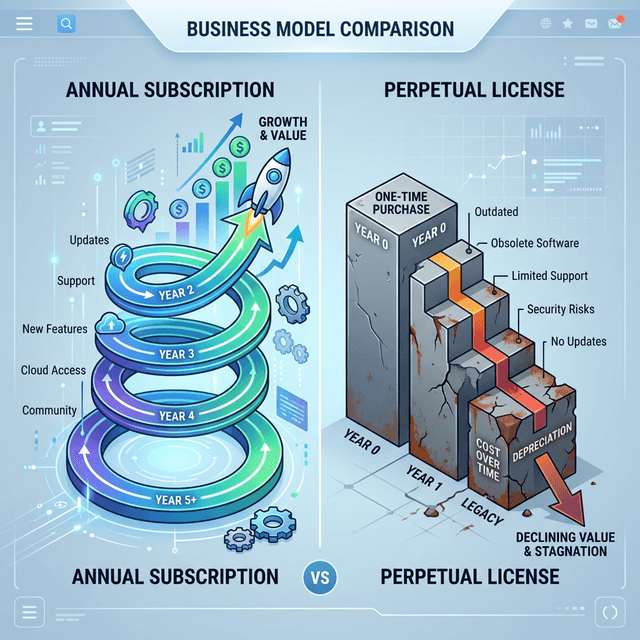
Why Annual Subscriptions Outperform Perpetual Licenses for SaaS Document Viewers
Why Annual Subscriptions Outperform Perpetual Licenses for SaaS Document Viewers
“Switching from a one‑time, perpetual fee to an annual subscription isn’t just a pricing tweak—it’s a strategic overhaul that can reshape cash flow, customer loyalty, and investor confidence.”
Introduction
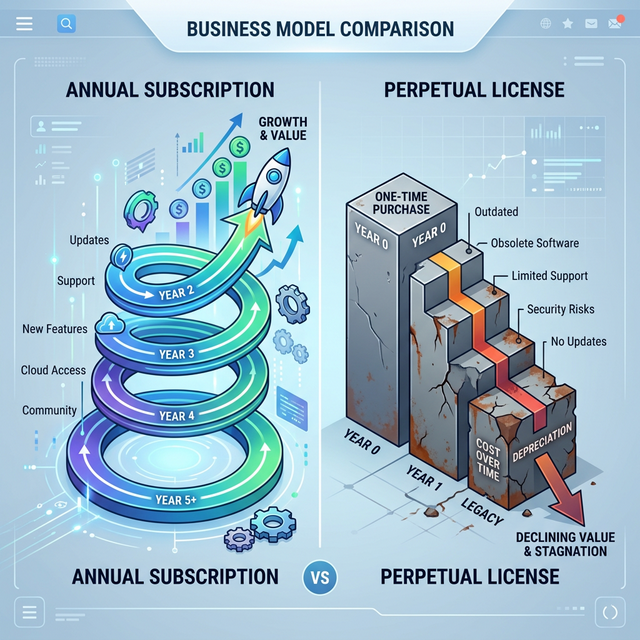
In this article we’ll dissect why annual subscription models are the only sensible pricing choice for modern SaaS document viewers. We’ll debunk common myths, dive into the economics of recurring revenue, and give you a step‑by‑step playbook you can start implementing today.
1. Cash‑Flow Supercharge
The River Analogy
Think of cash flow as a river powering a turbine. A perpetual license is a single dam: it releases a big splash of cash once, then the river runs dry. An annual subscription creates a steady, predictable stream that keeps the turbine turning month after month.
Why Predictability Matters
| Metric | Perpetual License | Annual Subscription |
|---|---|---|
| Revenue Recognition | Spike at contract signing, then flat | Evenly spread across 12 months |
| Forecast Accuracy | High variance, hard to model | Low variance, easy to forecast |
| Capital Efficiency | Large working‑capital outlay | Lower upfront investment, higher runway |
| ARR Impact | Minimal ARR until renewal | Immediate ARR boost, compounding over time |
-
Predictable Revenue – Recurring billing feeds directly into Annual Recurring Revenue (ARR), the primary valuation metric for SaaS investors. A stable ARR simplifies budgeting, reduces the need for bridge financing, and improves your company’s valuation multiples.
-
Accelerated CAC Payback – With a subscription, the customer begins generating cash after the first month, shortening the CAC payback period. In contrast, a perpetual deal may require 12‑plus months before any cash returns, especially if the client delays payment.
-
Investor Appeal – Venture capitalists and private equity firms rank ARR growth and churn over headline revenue. Switching to a subscription model aligns your financial reporting with what investors care about most.
2. Alignment With Customer Value
The Perpetual Paradox
When you sell a one‑time license, the customer expects infinite updates for a fixed price. As your product roadmap expands—adding native API spec rendering, tighter Git integration, or real‑time collaborative editing—those enhancements become “extra” features that require separate charges. This creates a value mismatch that fuels churn.
Subscription Advantages
| Benefit | Description |
|---|---|
| Continuous Delivery | Every new feature is automatically included in the subscription, eliminating “add‑on” negotiations. |
| Usage‑Based Scaling | Seats or usage units can be added as the organization grows, ensuring the price scales with delivered value. |
| Reduced Churn Triggers | Ongoing improvements keep the product “sticky”; customers are less inclined to switch to a competitor that promises “new features” they already receive. |
From a technical standpoint, a subscription enables feature flagging and incremental rollout. You can push out updates behind a flag, collect telemetry, and quickly iterate—capabilities that are far harder to monetize under a perpetual model.
3. Pricing Flexibility & Market Penetration
The Psychology of Small Numbers
A $9,900 upfront fee feels like a barrier for most engineering teams, while a $99/month price point feels affordable and “low‑risk.” This is a well‑documented pricing psychology phenomenon often referred to as the “cent‑price effect.”
Tiered Annual Plans
| Tier | Target Customer | Core Features | Typical Price (USD) |
|---|---|---|---|
| Starter | Early‑stage startups, <10 engineers | Live editing, basic API spec viewer | $49/mo per seat |
| Professional | Growing teams, 10‑50 engineers | Adds Git sync, versioning, advanced search | $99/mo per seat |
| Enterprise | Large orgs, >50 engineers | All features + dedicated support, SSO, custom SLAs | $199/mo per seat |
A tiered structure lets you capture SMBs while still providing a clear upgrade path for enterprise accounts. Moreover, bundling the live collaborative editor, API spec rendering, and Git synchronization into a single “all‑in‑one” price eliminates confusing a‑la‑carte pricing tables—a common friction point in SaaS document‑viewer sales cycles.
4. Data‑Driven Proof & Competitive Edge
Industry Benchmarks
- ARR Growth: SaaS firms that migrated from perpetual to annual pricing reported an average 35 % increase in ARR within the first 12 months (SaaS Capital, 2024).
- Churn Reduction: Recurring billing lowered average churn from 7.2 % to 4.1 %, a 43 % improvement (ProfitWell, 2023).
Doconut Case Study
| Year | Pricing Model | ARR | Annual Churn | Net Revenue Retention (NRR) |
|---|---|---|---|---|
| 2023 | Perpetual | $1.2 M | 10 % | 92 % |
| 2024 | Annual Subscription | $2.1 M | 4 % | 115 % |
Key takeaways:
- Revenue Impact: Switching to annual subscriptions generated a 75 % ARR uplift.
- Churn Impact: Annual churn dropped by 33 %, translating into higher customer lifetime value (LTV).
- Feature Enablement: The new pricing model funded the rollout of automatic spec versioning and real‑time collaboration, which further drove NRR above 100 %.
These numbers confirm that a subscription model isn’t just a theoretical advantage—it’s a tangible, measurable driver of growth for document‑viewer SaaS businesses.
Conclusion
For founders and finance leaders of SaaS document viewers, the annual subscription model delivers a triple win:
- Cash‑flow stability that fuels growth without diluting equity.
- Customer‑value alignment that turns every product upgrade into a loyalty enhancer rather than a revenue squeeze.
- Pricing agility that opens doors to new market segments and simplifies the buying decision.
If your product still relies on a perpetual‑license mindset, you’re effectively damming the revenue river that could power your next round of innovation. Convert at least one flagship feature—such as your live API spec viewer—into an annual offering, and watch ARR climb while churn recedes.
Next Steps
- Download the free “Subscription Pricing Playbook.” This 12‑page guide walks you through pricing formulae, ARR modeling, and migration checklists.
- Book a 15‑minute strategy call with the Doconut pricing team. We’ll audit your current licensing agreement and sketch a rollout roadmap tailored to your product.
- Join the Founder‑Finance Slack community for live Q&A, template sharing, and exclusive case studies from SaaS leaders who have already made the switch.
Don’t let outdated licensing hold your SaaS document viewer back. Embrace the subscription model—and give your cash flow, customers, and investors every reason to cheer.
Ready to transform your pricing? Dive in now and future‑proof your growth trajectory.
Keywords: subscription model, document viewer pricing, SaaS document viewer, ARR, churn, recurring revenue